Strava

Thursday, 18 April 2013

Race review: The Pain Barrier, Frickley. 13/4/13

Say hello in the comments or tweet me: @scott_leach

The very brief period at the start when I was clean

I really ought to be a little more careful to check out the crazy races I do before I sign up for them. In the high of finishing the Men's Health "Survival of the fittest" last year, I signed up for this 10k "mud run". The obstacle course in Manchester had been fantastic fun and I searched on line for something else a bit mad to do. This one sounded like a good idea at the time....

Fast forward a few months and the day of this one loomed very large, in a very inconvenient spot as the end of my marathon training was coming up. I seriously considered not doing it as I still needed to fit in my final long run before the marathon and I had almost no idea of the effect a mud run would have on me. And little did I know.

The first conundrum was what to wear for such a race. Gok Wan really ought to do a program on this kind of thing, although perhaps practicality might not be his first concern.
A lot would depend on the weather of course. As usual I set off with a variety of options in my bag so I could change if I needed to when I got there. In the event, the weather was pretty warm. I decided on a pair of above-knee lycra shorts, a long sleeve compression shirt and a dri-fit t-shirt over the top. The t-shirt turned out to be a mistake as it soon became very heavy and wasn't necessary, however, I didn't really want to inflict the sight of me in a compression shirt on the general public without a t-shirt to hide some of the man-boobage. I also needed to decide on whether to wear my GPS watch. I really wanted to be able to tell how far in to the race I was, but didn't want to break a pretty expensive piece of kit. I checked out the specs and found it had an IPx7 rating. Having been an engineer I knew this to be a high ingress protection score, so I decided to wear it. Half way through the race as my hand and arm sank fully in to the mud for the umpteenth time, I wondered if I had made a mistake. There was so much mud on the watch that it was impossible to read at times and wiping it with my muddy hands didn't have a lot of effect, I was spreading the mud more evenly instead of wiping it off. I did manage to just about wipe off the bit with the distance on it though, so it proved useful. Thankfully, it still seems to be working and I have used it since.

My unrealistic expectation of the race was that there'd be a bit of mud, maybe a couple of water crossings and I'd probably go round in 45-50 minutes. Talk about naivety! As the race unfolded, I found I had seriously underestimated just how tough this was going to be.
Looks like a baby crawling on the ground, which is exactly what I felt like.
As I lined up at the start I looked around, eyeing up my "competition". I certainly wasn't deluded enough to think I could win it but no one seemed confident to take a place at the front, and in fact, the people at the front were a few metres from the start line, no one wanting to toe the line. It seemed only a few people were actually keen to try to set a fast pace. The general consensus behind me was of simply "getting round".
Suddenly a little voice spoke up in my head and said "We could finish in the top 10 here". I replied with "What's with the "we", pale face?".

We set off after a few minutes of comic relief when the inflatable Saucony arch collapsed at the start line. Oddly, the same thing had happened when I did the Wetherby 10k last year. And no, I am not going around puncturing them. A few people went off  hard, and I set off at a fairly quick pace of around 4 mins/k. For the first couple of k the course was a dry and reasonable trail and I thought I had better crack on while the going was easy. It really didn't last......

After leaping a couple of ditches, the hills started. Let me get this straight, the people who set this event up are evil, evil I tell you! Not content with running a race on a 4x4 track liberally spackled with man-deep holes filled with mud and water, they had set the course to run up and down the nastiest hill for probably miles around, not once, but at least 2.8 billion times. Well ok, it was something like 4 or 5 times, but it felt like a lot more. The hill was so steep it was impossible to run up, in fact, it was pretty much a scramble. As I said, evil! The effect it had on sapping the strength from my legs was pretty impressive.

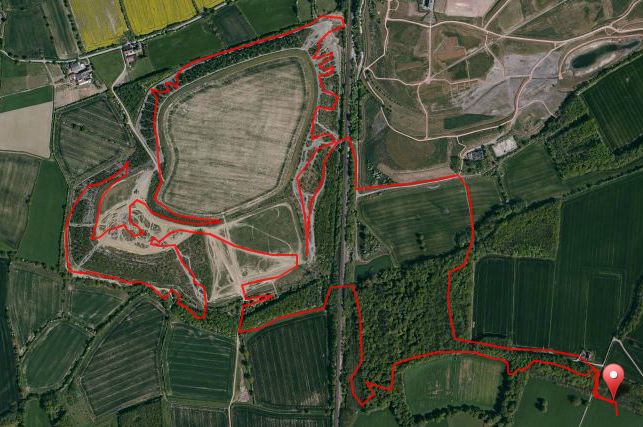
As my brain is now trying to block out the memories of the race, trying to recall the exact order of the things we did, even while looking at the map, is tough, so forgive me if I get slightly mixed up. As we came down the massive hill for the 7000th time we entered the biggest water obstacle, so large that a rope was needed to pull yourself through it.

I enter the pool at about 1:08 in the yellow shirt. What the video in the link below doesn't show is that there was a couple of feet of mud underneath the water. Half way across I heard someone in the crowd shout, "Swim, it's easier" It sounded like good advice so I set off.


Nearing the end of the biggest pool

Swimming past the guy in front of me put me in 5th place at that point. Another thing that wouldn't last.

The course continued through huge deep ruts in the land, in the main filled full of muddy water. At times the mud was thigh-deep. Having already lost most of the strength in my legs from the hills, dragging my legs out of the mud time and again was beginning to seriously take its toll. I have no idea where it was on the course, but at one point we entered yet another swamp. This one was nipple-deep and mostly mud. It had to be 30 metres long. Time and again my right leg jammed solid in the the mud. Eventually it became so difficult to keep lifting my legs out that I decided an army-crawl would be a better tactic. It was, but it came with the price of utterly covering me in mud and saturating my already heavy shirt. Worse than that, as we neared the end a splash of muddy water hit me square in the face from a competitor in front of me. I was wearing contact lenses, which helpfully decided to hold some of the mud underneath them and cause me a lot of pain and also meant that I was running through a fog of mud for the next couple of k. I was just beginning to think I might have to pull out and seek help, when suddenly they cleared and I was ok, just about.

This could have been pretty much anywhere on the course

At 6k in to the race I was blowing harder than I ever have in my life. I was beginning to find religion and was praying to any deity that would listen for this torture to end. My shoes AND socks were full of mud, gravel, rocks and god knows what else. Then mercifully there was a section that was on dry land. It was a heavy track, but still, no mud and water at least. I cruised along trying to recover on the hoof, and managed it to some extent. At some point I stopped and emptied out my right shoe. It didn't help much.


More mud, swamps and water and my feet were becoming a real problem. I could feel the rocks and gravel digging in to them from all angles. My arches were beginning to bruise and feel painful. I had no choice but to stop and empty out my shoes properly. I really wanted to carry on rather than stop as I was pretty far up the field and was on course to make my goal of a top ten finish, but my sensible voice spoke up and reminded me of my marathon training and that I couldn't afford to damage my feet. Emptying out my shoes and socks was a much more difficult task than I had anticipated. I need to squeeze them off and the socks needed to be flicked inside out as well as cleaning off the outside, so much debris had worked their way in to them. I probably should have just discarded the socks in hindsight. I had trouble getting my soaking wet feet back in the shoes and by the time I started running again at least 3 minutes had elapsed and annoyingly at least 10 guys had passed me. However, my feet now felt comfortable again and I set off to try to chase down the people who had passed me. I managed to catch a couple before the end of the race, but I was so shattered at this point that it was as much as I could manage.
Full on monkey-gurn mode

Then it started to finally become fun. We entered a tunnel that I think passed under an old railway line. It would have been stupid to run through it as it was too dark to see my footing and the roof got lower and lower as I neared the end. A lot of spectators, including children, had positioned themselves at the end of the tunnel and I could hear them screaming as soon as I entered the tunnel. It was a great feeling being cheered though the tunnel then bursting out in to the forest with the kids going wild and lots of shouts of encouragement. I got a small cheer for springing up on to the bank and off I went again.

The course zig-zagged through the forest and then spat us out in to the biggest mud patch of the lot. It was just about shallow enough that I was able to force my legs through it instead of having to army-crawl. The presence of children was the only thing stopping me screaming out a constant commentary of foul and disgusting language.
I had no idea how far I had still to go. My GPS watch had lost signal on a couple of occasions (Something it has never done before) and was telling me I had at least a kilometre left. So imagine my relief when I rounded the final corner and found myself staring down the finishing straight. "This one is shattered" I heard someone comment in the crowd. Not having that, I thought. I summoned up my last reserves of strength, put on my war face, and sprinted to the finish.

Doing my best to sprint impressively through the finishing line

I crossed the line in 1:05:14, 19th position. Only 3 people out of about 340 went under an hour- that's how hard it was. In the last pain barrier they'd run in Parkwood, the winner had done 43:06, the Frickley course was at least 5 points higher on the evil-psychopathic- genius scale. I was gutted to have finished outside the top 10, which is, of course, a ridiculous emotion for my first (and probably only) mud run. Having to empty my shoes cost me, but then, everyone else was dealing with the same problems, maybe they just ran on with shoes full of gravel?

The leader board.

Stig of the dump, or possibly me, not entirely sure.

After I crossed the line the MC pushed a microphone in my face. It took a minute for me to catch my breath and indulge in some "witty" banter. I waffled something about having sunbathed for 20 minutes half way round and regrettably cracked the obvious and almost certainly oft-repeated mud-being-good-for-the-skin-"joke" . Afterwards I was sorry I hadn't thought to accuse the organisers of breaking the Geneva convention.

The mud pack at the spa I had booked left a little to be desired

Lessons I learned from this race:

1) Check out what I have let myself into BEFORE I turn up.
2) Train for the race. Road running does not prepare you for this kind of insanity.
3) Football socks, tied at the top would have been a much better idea than the shoes liners I was wearing
4) Sod vanity, next time, a short-sleeved and unflattering compression top is favourite!
5) It's amazing how much you want to punch people when they shout things like "It's not called the pain barrier for nothing" 6k into the run when you are totally shattered. Luckily enough, even if I were so inclined, I wouldn't have had the strength to commit the ABH I would have liked to at that point.
6) £100 pairs of Saloman goretex trail trainers are not much help in these situations. That said, they stayed on in the face of extreme provocation and never felt like they were about to be lost in the mud.
7) Running wicking athletic gear such as lyrca shorts and compressions tops under a shower whilst constantly squeezing and massaging them for half an hour will not remove this sort of mud, in fact, it didn't seem to help much at all, the water coming out of them was still dark brown.

After the race I spent quite a lot of time saying how I would never enter another event like this, that it was too much and I would rather do pure obstacle races in between my road and trail races. But predictably, I now feel like having a crack at another and trying to get in to the top 10 with some more specific training.

The event on the whole was very well organised. There was no queuing when I registered around an hour before kick-off. The car parking was well organised and very close to the start. I felt a few more port-a-loos could have been provided, but it didn't take long to get in one. The MC did a good job and kept up the energy well before the race. I was a little disappointed that there was no beer tent, but I did leave fairly quickly after the run so I am not sure if the registration tent started serving later. The medal and tech t-shirt are very nice designs and felt like suitable winnings at the end.


Damage report:

Thighs quite sore for about 3 days afterwards. Ankles felt like they had been battered with a cricket bat. Cuts to the back of both ankles. I am still picking splinters out of my hand 5 days later. Thankfully, little else!

All in all a well run and enjoyable (in a sort of masochistic way) race. This was a very serious challenge and the name "The Pain Barrier" is very well deserved. Would I recommend it? Hell, yes, if you're as big a nutter as I am.


Monday, 15 April 2013

The sad news from the Boston marathon

As I type, the shocking news is still unravelling about the incidents at the Boston marathon. It doesn't seem right at this minute to bang on about my week's running.

For those of you who don't know, currently, the news is that two bombs have exploded at the finish of the Boston marathon, killing 2 people and injuring up to 50. A third explosion took place at the city library. Although we don't know exactly what has happened yet, it seems more than likely the explosions were caused by bombs.

It's difficult to express the contempt you feel for people who perpetrate these terrible crimes. We can be fairly sure this isn't an attack on runners as such, but a strategic hit on a very large public event designed to cause maximum disruption, terror and fear.

The anger is boiling in me, but of course, this is exactly the emotion that allowed the psychopaths who did this to carry out their actions. Instead I will tunnel my actions in a positive way. I will run the Manchester marathon remembering the people killed and injured in Boston. Rather than the fear that this was supposed to spread, it will galvanise me and has made me more determined than ever to complete my first marathon in 2 weeks.

My thoughts and sympathies go out to all the people affected by this moronic and terrible event.

Monday, 8 April 2013

Marathon training: A suicidal schedule

When I finally began to believe that I could actually run a marathon I signed up for Manchester in September last year, around 8 months before the event. I had just completed the Great North Run with no ill effects at all and feeling great, so it seemed like a good idea. What could possibly go wrong? Judging by my luck, anything up to, and including, a nuclear war.
A couple of months down the line, however, things were going great. I wasn't following a set plan; I felt that decent physio and running experience had given me enough knowledge to be able to listen to my body and judge what I was able to do without one and it was working.
On December the 3rd I had built myself up to a 20 mile run. It went very well. I was tired at the end, but had no aches, pains or blisters. After the run I remembered the best bit of running research I have heard in a long while; that the best thing to consume after long runs for recovery, is chocolate milk. I don't care if those good professorial types at the university have got it totally wrong, I am going to believe that piece of research until the day I die!
The next day I had the tiniest amount of soreness and that was it. I was ridiculously pleased. Considering my injury record this was a real triumph. My thoughts turned from just finishing, to finishing in a (relatively) decent time. All was well.
Then I got ill. I had always supposed that if anything would scupper me, it would be injuries, illness hadn't even occurred to me. Still, it was just a bad cold, it'd be gone soon enough, right? 10 days later, I was just about better and previous experience had taught me that I could run at the very end of a cold and the resultant boost to my immune system would kill off the last of the cold.
As it turned out, I learned a valuable lesson that day; whilst a run may help to finish off a dying cold, a too long run may well start it up again.
The cold came back with a vengeance and all its mates. Another 10 days later the germs were just about done with their party in my sinuses. I tentatively started running again. A few days later, I got flu (real flu, not one of those bad colds that people get and call them flu) for only the 3rd time in my life. My temperature was raised for 5 days, and for 3 of those days it was above 39 degrees.

When the flu finally buggered off back to the bowels of hell from whence it had come, my chest felt like that of a 70 year-old career smoker. I'm sure my asthma didn't help with that. Worse than that though, was that my calves had forgotten that I am a runner and had decided to retire. When they were forced to get out of the rocking chair and grab a zimmer frame, they retaliated by tightening up during every run.
No problem though- I had had this happen before. I ran through what solved it last time. Taking my time building the distance, frequency and speed of my running; ice, heat, massage and glute exercises.
To cut a long and  not-very-exciting story shorter, time has started to seriously run out before the marathon.
I realised that my long run each weekend would need to to increase dramatically each week. More than dramatically, drastically, dreadfully, draftily. (I may have run out of words at the end there)
And so I set myself a suicidal schedule: 10 miles, 12, 15, 18, 22, marathon. No time for tapering.
Last week was the 15. It wasn't good. At 6km my calves were sore, at 8km they began to be painful. By 12km they were fine again and I only just felt them for the rest of the run. At 16km my right shoulder began to hurt like a tooth ache and stayed with me for the next 2k. At 19km my left hip started to hurt and became very painful. It helpfully stayed with me until the end of the run. Finishing was a real mental effort (in both senses of the word) 
The next day things were a lot better than I feared. Not too much soreness. I was hanging on to the plan by the skin of my teeth. A sports massage on Wednesday had me feeling much better and I managed a 45 minute 10k and a nice easy 5k.

This Sunday dawned with mercifully better weather for my 18 mile run. I even donned shorts for the first time this year. And nery a boat crashed in to the rocks of Leeds that day thanks to the light houses that are my lower legs. 
I set off at a ridiculous pace, especially considering last week's run. But I listened to my body and it was fine. I decided to trust how I felt. The run went well. This time no hip pain. The calves were sore, but they weren't that bad and they didn't get worse and at times I couldn't really feel them. I completed the 18 miles in 2 hours 15, at a pace 10 seconds per km quicker than the 15 miles the week before.I couldn't help but feel that a lot of it was due to this week's reading.........

Scott Jurek's book, Run and Eat, is a fascinating read so far (Don't spoil the end for me, I have 60 pages to go) His tips about remembering to enjoy running, on breathing and the psychology helped me during the 18 miler.

Today I had a wonderful moment that I described as being like finding money in the pocket of a jacket you haven't worn for months, but not just a tenner, more like £100! I realised that I had miscounted when I calculated the time I had left until the marathon. Turns out I have an extra week. 


Tuesday, 26 March 2013

Running kit: Modern trainers are a curse

That's right, thought I may as well put the controversial bit in the title, but we'll get to that later.

In my experience I have found that there is more snake oil in sports goods than the reptile house at Tropical World.
Last summer a team at Oxford University examined 431 claims in 104 products. Here's the BBC report on the study and here's the abstract on the BMJ (British medical journal) site. And basically, they discovered it was all pretty much nonsense at worst, and hugely exaggerated at best.
I first started to suspect that something wasn't quite right with what sports goods manufacturers told us when I was constantly told to "drink, drink, drink" from numerous different sources. It just didn't seem to make sense, especially when I was running only 10k on a cool day. When various fancy trainers started to cause me problems, I began investigating and found that there were studies that backed up what I found.
And don't start me on sports drinks, we'll be here for ever!

But anyway, let's try to be positive, it's not all bad....

My Dad did most of his serious running in the early 80s. I think technical materials were around at that time, but obviously, they weren't up to today's standards, nor were they all that commonly used. My Dad ran in pretty much nothing but cotton. Today, I would find it really tough to run without my tech material clothing. Maybe I should explain what I mean by tech material? Here's some of the properties and advantages they have over cotton:
Wicking: Modern materials draw moisture away from the skin as opposed to cotton, which stores it nicely and helpfully rubs it over your skin turning your nipples in to tiny scabs.
Flat seams: To help with chaffing issues. Those cotton seams can feel like razor blades after a few miles
Light weight: The materials start off light and because they don't hold the moisture, they don't feel like you're running in chain mail on a sweaty day.

As you can gather, I love modern running materials and it came as a huge revelation when I discovered it a few years ago as I had always trained in cotton shirts. The added comfort that being able to wear modern clothing; tights, jackets, buffs, gloves, socks, hats, etc, etc is huge.

Here's the sort of stuff I'm talking about, and no, I'm not a rep for Nike!!


And then there are GPS watches. Of all the pieces of running kit I own, I think this is the one that helps me most. I bought mine (a garmin 305) after having a look around a few running forums and seeing what was being recommended by the people actually using them.  I won't go in to a review of the one I own, but I'll tell you the benefits I find from using it. Being able to accurately tell exactly how fast I am running (To a point) is huge. Reviewing the data it collects after each run is incredibly useful and helps me keep track of my progress. I have so often found that runners under or over estimate the distances they run, so it's great to get accurate measurements. Also, I'm a geek, so I love the stats.
Some people prefer not to use GPS because they feel they can get obsessed with facts and figures and forget to enjoy their running. I see their point, but as a lot of my enjoyment in running is derived from challenging myself by lowering my times and upping my distances, I find it invaluable. If you run for other reasons than this, then GPS might not be for you.


Sorry about the blurry photo- I was excited (and knackered) after breaking my 10k PB.
The garmin connect site provides some great stats at your fingertips. It's nice being able to see how many miles I have covered each month in only a couple of clicks. Here's my page if you're interested.

So on to the controversial bit. Trainers.
I'll preface this bit by saying yes, I have read the wonderful "Born to Run" but my opinion is based on reading  around the subject as well, and more importantly,  from my own personal experiences.

In the early 70s the first cushioned trainers were released on to the market. This was a disaster.
Think about this; we evolved to be runners over millions of years of evolution. Why on earth would we evolve to require us to strap an inch of foam to our feet that needs changing every 500 miles or so? It doesn't make any logical sense. Evolution just doesn't make "mistakes" this big. Before the 1970s everyone ran in little more than plimsoles. The first 4 minute mile wasn't run on a foam cushion.

Don't believe we evolved to be runners? Read around the subject of  persistence hunting.

But! I hear you say, we run on pavements and concrete now! We need that foam!
Not true- studies have shown that the more cushioning we have, the harder we hit the ground. When you are forced to run as we evolved to do- on our toes- the correct natural gait takes over and the calves become our shock absorbers meaning we land much more lightly. The majority of us have grown up with controlling shoes with cushioning, so our bodies aren't used to this. It doesn't take too much time or effort to return to your natural gait.

Here's the next controversial bit:

"Gait analysis" in running shops is rubbish, total, total rubbish.

Let me explain by telling you of my own experiences:

When I started running again around 4 years ago I was a very heavy heel striker. My shoes wore away on the outer edge of the heel way before the rest of the shoes fell apart.
In I went to a specialist running shop and the shop owner (who is a very decent runner himself) "gait analysed" me. This involved watching me stand. (Yeah, seriously) He then sold me a very expensive pair of Mizunos. Don't get me wrong, I have a lot of time for Mizunos, they tend to make natural feeling comfortable trainers. The pair I was sold, however, were a bad idea for a heavy heal striker as they had little cushioning there. To give him the benefit of the doubt- maybe he was trying to encourage me to run on my toes. But probably not.
Fast forward a while and I was experiencing lots of different problems (Back pain, shin splints, plantar fasciitis, etc) Again I was "gait analysed" by a specialist running shop. This time using a video camera. I left the shop with expensive Asic gels. To cut a long story short, they caused me hip pain. It took me a while to work out that it was the shoes causing the problem because seriously, how could it be the expensive trainer's fault? The ones I had specially selected for me?
On to a pair of expensive, heavily cushioned Sauconys. I was doing pretty well in these, for a while. Then I developed a pain under the ball of my foot which I only got when running. Swapping to a different pair of trainers removed the problem immediately.

So here's what I discovered: Expensive trainers are very unlikely to solve any of your problems, but they sure as hell can cause a few.

Once again, I can hear people shouting....."But I bought fancy new trainers and all my problems disappeared!!"
You ever thought that maybe it wasn't the arrival of the new trainers that solved your problems, but getting rid of your old, knackered trainers?

Over time I came to realise that by putting my feet in to trainers that control, push and shove my feet in all directions meant that it was taking over the job of the muscles in my feet causing those muscles to weaken and actually worsen my problems. I felt immediate improvement when I ran some very short runs in barefoot trainers. Through experience I realised that using very simple trainers, with less and less control and support actually improved my injury rate. I naturally moved from being a heavy heel-striker, to a mid-sole runner. When I say naturally, I never consciously tried to run differently, but by doing the exercises the physio recommended, it changed all by itself

After I discovered this I found that there was research to back this up. In one study people who had been "gait analysed" by running shops and bought recommended trainers were compared to people who had just chosen their trainers on comfort and fit, straight from the shelves.

There was no difference in the injury rate. None. Zero.

You pay out all that money for the fancy, top-of-the-line trainers, and for that, you get nothing. McDougal in "Born to Run" mentions a study by Dr Bernard Marti  that showed that high-end trainers actually increased your injury risk by 123%
If we want to be cynical, we could say that people who buy more expensive trainers are probably putting in more miles and are maybe already having injury problems, so you might expect there to be more injuries. But 123%? Well, no. And I would hope Dr Marti considered these factors in his study.
Besides, stats show that you have a huge risk of running injury no matter who you are, fat, thin, short tall, male, female, distance runner, sprinter, weekend runner, or obsessive nutter, your injury risk is pretty much the same.

Every beginner's running advice that I have ever seen has always included the immortal line "Get the right trainers" usually followed by advice to get a specialist shop to fit you "properly"

In my opinion and experience, the "right" trainers are simply ones that fit you well and are comfortable. If you buy trainers that "support" your muscles, you will make those muscles weak and that will lead to injury. Instead, work on strengthening all the muscles required to run and you will prevent against injury rather than treating a symptom.

Here's my current trainers (I also run in a pair of Brookes green silence), next to a really, really big leaf (My feet aren't small, honest!)


Ok....ok......here's my full collection.....


Fine, I admit it, my name is Scott and I'm a trainerholic.

I haven't gone in to food and drink supplements here, that is a huge and very complicated subject which although I have my opinions on, I probably don't have enough knowledge to discuss fully. 
That said, here is my very basic opinion: Eat as much natural, unprocessed things as you can. If you need to take supplements, then your diet probably isn't right.

So to conclude, sports goods: Don't believe all the hype.

P.S. I am aware that the phrase "In my experience" is dangerous, because the easiest person to fool, is ourselves. Here's an article that's very interesting in itself, but also discusses this issue (Read through it to find the bit I'm talking about)


Monday, 18 March 2013

My journey from injured crock to marathons


My Dad was always a runner for as long as I could remember. ( I use 'was', not because he's no longer with us; he's still going very strong in his 70s; but because sadly, he no longer runs) After years of seeing him head out the door for his long runs, I asked to go with him. For a while I regularly accompanied him on his short jogs around our local area, although I would stop and cut off a large corner then wait for him as he ran the longer route. I'm really not sure if that was for his benefit or mine.
Different sports then took over as I got older. I represented my city and county at rugby league, swam for my school and played football on and off amongst other things, but I always returned to running having managed to pass the point of needing to motivate myself and finding a place where I simply enjoyed getting out there.
When I was 23 and a student nurse, I developed a hernia. Men generally get inguinal hernias and women femoral hernias, so of course, mine was femoral. The NHS waiting list meant that from diagnosis to the operation to repair it, was 9 months, which I considered pretty good at the time. As I didn't want to aggravate the condition I stopped any training until the operation. Probably the only time in my life when I wasn't doing anything.
By the time I had the op and was ok to start training again, I couldn't wait and threw myself in to running and training with the local rugby league team. Within a few weeks my shins were painful, but I ignored it and carried on. The only injuries I'd ever had in my life were due to trauma from things like twisted ankles and big tackles, so a gradual onset pain was a new experience to me. Eventually I was referred to a physio and that's where it all went wrong for a very, very long time.

The physio gave me some truly terrible advice and some truly terrible treatment.

"As soon as you feel shin splints coming on, you should stop running for 6 months"

This is, of course, utter nonsense. The term shin splints is a description of a symptom- shin pain- and not a diagnosis or a cause. Shin pain can be caused by a whole multitude of problems and it very much depends on the cause as to what treatment you need. A blanket "Stop training for 6 months" is just rubbish. Sadly, I believed this piece of advice for many years afterwards. He went on to "treat" my condition with ultrasound and magnetic treatment. Neither, I believe, has any basis in science or research whatsoever. Even the seriously wooly thinking behind these treatments only really claims to treat acute pain and not solve the cause. Unfortunately, "therapists" are still using these techniques.
After a few week's rest and "treatment" the pain had all but gone, but unsurprisingly, it came back pretty quickly as soon as I started training again. Remembering the physio's advice, I stopped running again. Without any decent or correct preventative treatment for the cause of my shin splints it was unlikely to ever go away.

For the next 10 years I did very little running. Occasionally I would try again and soon the shin splints would return, at which point I would remember the advice and stop. Numerous times I gave up all impact training for 6 months and more, only for the shin splints to return as soon as I took up running again. Eventually I became resigned to the fact that I would never be a runner again and began going to the gym instead and using non-impact cardio machines.
I longed to don a pair of trainers and get out there
About 4 years ago I became so frustrated at not being able to run I decided to give it one last go. My father has marathon medals and my brother half marathon medals and so help me, I wanted a medal too! At that point you didn't really get medals for 10k races, so I knew I would need to run 13.1 miles to win that illusive medal. I determined to start it up very, very slowly and see how it went. I started with literally 2 minutes on the treadmill each time I went to the gym. After a couple of weeks I tried 4 minutes and a couple of weeks later 8 minutes. Over the next few months I worked my way up to 20 minutes. Buoyed by this limited success I went out for my first run outside in a decade. And it actually went well. Tentatively I continued over the next few weeks until the next problem hit. After around 20 minutes running I would get a short, sharp pain on the inside of my knee. Off I traipsed to the GP again who referred me to the knee clinic (Who knew they existed?!) After a CT scan the surgeon diagnosed a torn meniscus ligament. He offered me an arthroscopy (A camera into the knee to try to identify the problem and possibly some treatment, a "clean up")
I decided I may as well go ahead as I had nothing to lose. I could tell he was "managing my expectations" as he explained the procedure to me playing down the possible benefits and that it might in fact, have no affect.
I seem to remember he casually threw in that physio might be able to help, but he seemed so unconvinced I thought nothing of it.
Whilst waiting for the arthroscopy, I got a new job and moved to Leeds so I never did go under the knife. I decided, that as I could run without pain providing I was wearing a knee support, that I wouldn't pursue the op with my new GP, afterall, it seemed likely that the problems would recur and I'd end up having to have it done again. I did decide, however, that I would put down some serious money and go see a proper specialist sports physio.

And that's when my whole life changed and very much for the better.

Searching on line I found prosport physiotherapy . To my surprise it wasn't as expensive as I feared and I went off for the initial assessment with Martin, one of the directors. In that first session I remember him asking me what my expectations were, what did I want?

"I want to run marathons" I said. Never really believing it to be possible. I had entered his treatment rooms at the Leeds Rhino's training ground in Kirkstall with a whole list of pains and injuries. Starting from the bottom up:
Plantar pain (Pain on the sole of the foot)
Ankle pain
Shin pain
Hip pain
Knee pain
Lower back pain

I honestly gave him no chance of fixing me. But then, for the first time ever, a physio gave me a proper assessment. He looked at me as a whole, not just at one of my individual problems in isolation. I had seen many physios over the years, but each one had treated only one symptom at a time (I should point out these were NHS physios, apart from the initial one who gave me the worst advice, and as such have very limited time)
He assured me there was nothing mechanically wrong with me, no misplaced knee caps or swollen bursars and that he would get me running marathons. I can't say I really believed him, but it certainly gave me optimism.
"How many sessions will I need?" I asked. He basically replied "Depends" but in slightly more words. I became a little more sceptical, every therapist I had been to had told me how many sessions I would need. I asked what knee support I should use as I found them uncomfortable and difficult to keep them in place. I remember clearly that he said, "You won't need one"

Oh

I decided I had wasted my time and my money. I had a torn ligament- the surgeon had told me that, how would physio be able to manage that?

In the next few sessions Martin ran through my problems and gave me exercises and stretches to deal with each one. My ankles had no mobility, so he gave me stretches. My knees turned inwards as I hit the floor, so he gave me exercises to strengthen the muscles. My IT bands were almost entirely solid so he gave me painful deep-tissue massage and showed me how to use a foam roller. My over-sized thighs controlled my gait, so he gave me exercises to activate my glutes. (It's a weird experience to have physios prodding at your buttocks)

Foam rollers are evil implements of self-torture, but nothing compared to the hockey-ball-in-the-buttock torture
Two weeks after the first physio session, I stopped experiencing knee pain and have never had it since. The shin splints eased pretty quickly and thanks to Martin's advice I no longer worried that I was doing myself serious damage each time I ran. The pain moved around my body over the following weeks and the exercises changed and became more intense and I continued to receive the deep-tissue massage. Things improved immediately from the initial session though and I became convinced that I would, eventually, become a runner again.

There were set-backs of course. I developed hip pain and we struggled to get to the bottom of that one, until it turned out to be the very expensive Asics gel trainers I had bought on the advice of a shop assistant who had "gait analysed" me. (More on trainers and "gait analysis" in a later blog)

The only problem that Martin did not manage to solve was the plantar pain. I had followed all the accepted advice to try to solve the problem (rolling a can from the freezer under your foot, etc) and had even had a steroid injection in to the foot, all to no avail. Martin gave me exercises to improve the muscles in my foot and strengthen the arch which helped, but did not completely relieve the symptoms. The odd thing about my case, was that the amount of running, or walking I did, seemed to make no difference to how much pain I did or didn't get from it. I did however, eventually find a cure and have not suffered from it for probably 6 months now. Martin had recommended that I see a sports massage therapist once a month as I tend to suffer from tightening muscles so I began to see Jim Mason. I mentioned to Jim that I suffered from this condition and he casually mentioned that sometimes a tendon in the sole gets a bit tight and massage can help it. And I thought nothing of that either, until late in to session, he decided to work on it.....
A searing, burning pain shot through my foot as Jim's thumbs dug in to the sole of my foot. The pain was excruciating, but it was over as fast as it had begun. I have not suffered a moment's plantar pain since. I still go to Jim around once a month to keep my muscles from seizing up.

So I realised that Martin's reluctance to tell me how many sessions I would need was entirely correct. You just can't guess that. It all depends on how well you respond to treatment and if you bother to do the exercises and stretches that you are given. I did mine obsessively. I was very short of money and needed to spend as little on physio as I could. At that time, most of my spare cash was going to the physio and I have never spent better money in my life. It gave me back my running life and I will be forever grateful for that.
Martin is very keen to teach you how to manage your own body (and thus creating less work for himself, but what he loses in you requiring less sessions, I am sure he gains in recommendations) So now I feel that I can handle most problems that come up.

As time went on I managed to run more often, moving from two 5ks a week, to four 10ks. I had eased my way up to 11 miles when I lined up for the Great North Run last year. I was nervous as I hadn't got up to the full distance in training, but my brother eased my worries when he mentioned that he only ever trained for his halves by doing 10ks and I remembered that I had spent a long time training for 10ks with 5k runs.
 I won't go in to the actual race too much as I will probably write a full blog entry about the GNR some time but suffice to say, the run went far, far better than I could ever have hoped for, and I crossed the line in 1:34 smashing my expectations by some way. The crowd had carried me along. I was very proud of my winnings and here they are:


My journey to the marathon is not yet complete. My first marathon is booked and paid for in just 5 weeks time. Just 3 months ago I had worked up to 20 miles with no problems the day after and was feeling very happy to be well ahead of schedule. Unfortunately, I then spent 2 months being ill, culminating in a very nasty flu that knocked me back a long way. When I started to train again, I found my chest was terrible after the illnesses, but worse than that, I suffered from tightening calves again, a problem I had successfully got over a year previously. I thought back to how I had treated it and after a few weeks they got better. I went out for 11 miles and arrived back with no problems. Then I got cocky, and decided to go out for a run the next day, forgetting that it's usually sensible to rest at least a day or two after your longest run (another valuable lesson learned!). The calf tightness came back immediately. Having another think, I remembered that Martin had been very keen to get me to do more glute exercises when I had had the calf problem before, so I got stuck in to a few of them

And this is where I currently stand. My glutes are very sore from the exercises (proving to me I obviously was in dire need to work them as clearly they had got lazy from 2 months on the sofa!) My calves are still sore, even more so from the massage session on Friday that specifically worked the sore spot on my right calf. And the Manchester marathon is 5 weeks away. From hereon in, my training has to go exactly to plan
or I am in trouble.

Wish me luck!

Update: I have since learned more about plantar problems and that the popular term: plantar fasciitis is a misnomer; it's not caused by swelling so the traditional treatments, most of which are based around reducing swelling, don't work, which explains my story and the success I've found with massage.

Monday, 11 March 2013

Men in tights: The embarrassment of male running tights

Say hello in the comments or tweet me: @scott_leach

Camp!? Camp!?  Moi?

I lived in Brisbane, Australia, for a year during 2002-2003 where the average temperature in the winter is 18C and it turned me in to a total wimp. I grew up in Yorkshire, a generally cold and drizzly place, and didn't take too much notice of the weather. When I was younger if you'd told me tomorrow would be 10 degrees C, I couldn't have told you if I was going to need sun block or a duffle coat. But 9 measly months out there and I became a little girl when it came to the cold. Of course, 5 years with an Australian girl who was obsessed with the weather, complaining 20 degrees was too cold and 28 degrees was too hot, might have something to do with it.

I distinctly remember as a young man of maybe 18, going out running on Christmas day with the ground covered in re-frozen slush in old-skool shell bottoms, a cotton t-shirt and a sweat shirt. 5 minutes into the run, the jumper came off and was tied around my waist. People looked on at me with puzzled expressions, burying themselves in to warm, thick, padded jackets as I whizzed past them.
Years later when I re-entered the world of running, with my new-found wimpishness, I knew I would need to wrap up warm. However, being a Yorkshireman of course, I wouldn't be seen dead in tights, even though jogging bottoms feel so cumbersome.
But also.....being a Yorkshireman (the myth is that we're tight with money).....when a certain discount sporting goods shop happening to have some very nice full-length, thick, moisture-wicking tights in at a steal of a price.....well.....

Actually, wearing lycra (I believe lycra is "spandex" in America) came about before I decided to run in ridiculous degrees during the winter. A summer earlier, I really can't remember what possessed me to buy a pair of tight-fitting lycra shorts that ended above my knee. I guess they were probably on cheap......

Even after I had bought the lycra, I couldn't bring myself to run around Leeds in my bulge-shorts displaying my packed lunch for all to see, so I would always wear a pair of modesty shorts over the top. Although I did have to admit, the lycra was seriously comfy...

After a while I began to consider that perhaps, wearing the bulge-shorts for total comfort was slightly negated by the flappy shorts over the top. Maybe, just maybe, I should consider dumping the modesty shorts?! But surely, men should NEVER be seen in lycra?!?! Running forums often have the "should men wear lycra?" debate. Sod it, I would try it out at the local club's 10k in Horsforth. Surely amongst 600 club-runners there would be plenty of men wearing lycra?

Er yeah, I think there was 2. Bugger. The modesty shorts stayed on.

I continued to debate back and forth and eventully, at a 10k in Sheffield, I threw caution, and my baggy shorts, to the wind! It felt freeing! glorious! spiritual! Wonderous! Amazing!

Well, ok, it felt comfy. Here I am, the following year in Sheffield again (Same shorts):


I'm not sure when I decided I shouldn't go commando under them though, but still, I learned that lesson at some point.

Now that winter keeps coming back to say hello I am glad of thick, heavy winter tights. I don't care if I look like several badly-packed horse-meat sausages from a dodgy supermarket, they're comfy and they're as warm as I can get without running with my duvet around me (Tempting, tempting!)

These days I have completely stopped worrying about how I look when I run and really can't believe I ever worried about it. The key is to always totally look like you know what you're doing, even when you haven't a clue, that way no one questions your sartorial running choices.
So yeah, I am a convert to wearing lyrca and time will tell if I recognise the exact age when I really, really need to STOP wearing it. But for now, comfort reigns. And at least I haven't given in to wearing hi-viz yet!


Monday, 4 March 2013

Urban Adventure Running

I invented a new type of running tonight called Urban Adventure Running. What you do is, drive to a city that you don't know at all, then set off running without a map into a dodgy area. In fact, the dodgier the better; it all adds to the adventure. Then you run around until you're a bit lost trying to navigate using the stars, big buildings, bus stops and passing tramps. If you choose a port, I imagine you could also use the smell of fish to navigate by, or if you were in Newcastle, you could use the smell of barcardi Breezers so you would always know where the city centre was.

Well, OK, the parkour/free running lot have probably already got urban adventure covered and I did take my phone with me so was equipped with Google maps had it all gone wrong, but still....

Anyways, to explain a little further, I arrived in Birmingham today for work. Determined not to let the training slip I resolved to have a run from the hotel in the evening. But what do you do when you don't know a place at all? It probably doesn't help that my hotel seems to be in little Helmand. Google maps doesn't appear to have a "Places I am least likely to be stabbed/mugged" feature just yet (Come on Google, get on it!) However, I pride myself on not being faint-hearted and Edgbaston cricket ground seemed to be only 2 miles from my hotel. A pilgrimage to a ground I had seen many times on TV seemed like as good an idea as any. I had walked down some of the streets I would need to take to get there during the day as part of my job so committing the map to my photographic memory *cough* I waited for a lull in between the scuds and set off.

I hit my first problem before I had even raised a toe in anger. Usually I put my GPS watch outside whilst I am getting ready so it has found the satellites by the time I get outside, but of course, from a hotel that isn't possible. Waiting outside for the technology to latch on, I must have looked an odd sight bouncing around what is essentially an industrial estate, in a pair of tights.

Then my watch decided to screw with me. A classic computer "loading" bar appears on the phone and creeps onwards towards the supposed end when it's found the satellites.  So of course, you stand watching it like a kettle, cursing as the wind starts to bite, whilst slowly, slowly, slowly, it millimetres towards the end. Imaginary pages fly off a calendar, leaves turn brown, fall, and are regrown and suns and moons swap places in the sky many times over. And then. Just as it the little bar is complete.......It jumps backwards. Damn you technology! Ah well, sod it, I'll set off. Half a kilometre later, it's still fannying about and I can't stand it. So I reset it and stop running whilst it searches, looking like the dodgiest bloke ever as there really isn't a good reason to be standing around next to parked cars in an industrial estate at night. I mean, seriously, are there no satellites over bloody Birmingham?

Finally I can set off again. It's not long before I am in totally uncharted area to me and am now running on hope, faith and no charity. But, it's a big cricket ground, there have to be brown signs to it from quite a way away, right?
Yeah. Right
But amazingly, I actually managed to make it there. Here's the, blurry, fuzzy proof.


I have to admit, seeing the boys and girls in the training academy doing their thing, hoping to be the next big stars of the game gave me a bit of a thrill.

At that point I needed to make a decision- did I just turn around and retrace my steps, or did I circle around the ground and wing it? Without a thought for my own safety *cough* I set off in to deeper and darker Brum, risking life, limb, smart phone and Nike trainers.

I needed to use my sense of direction (never all that reliable) to try to work out a way back to my hotel. I decided it would be a good idea to stick to main roads as they were least likely to be dead ends. Could I trust the magnets in my head, though? At one point I ran in to a fenced in area and sheepishly had to turn around. One road I ran down that seemed to be a main road, suddenly turned in to a small housing estate. I expected the dead end to come at any point, but luckily it spat me back out on to a main road. I could see the larger buildings of the city centre and could use them to gauge direction. The streets began to look a little familiar and then I was on one that I knew. Home and dry. Amazingly, when I got back to my room and uploaded, the route I took was pretty direct.


It could have all gone wrong I suppose, but I guess we let our paranoia and the media scare us in to thinking that there are bad guys on every corner when of course, the bad stuff is very rare. What I did was safe enough and I am, of course, exaggerating for comic effect.

Or maybe the fact I was wearing last year's Leeds Abbey Dash t-shirt scared them off? No Midlander would be stupid enough to take on a Yorkshireman, surely?